

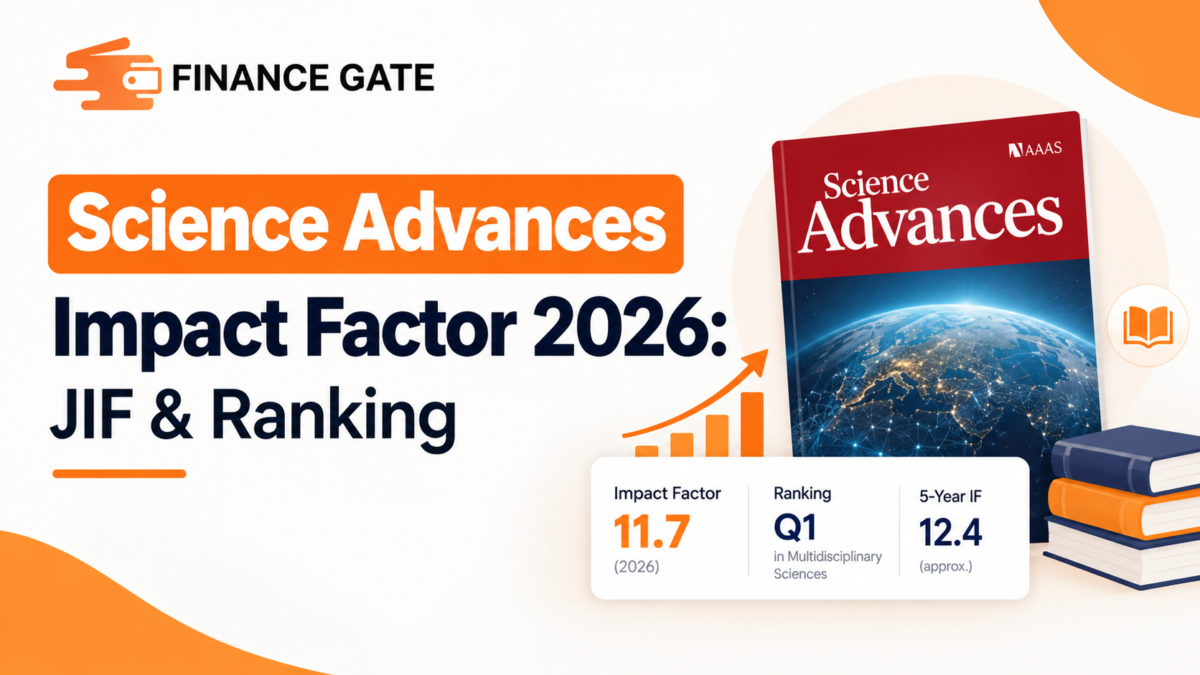
The latest reported Science Advances Journal Impact Factor is 13.9 for the 2025 metric year, published in Clarivate’s 2026 Journal Citation Reports (JCR) release. The journal’s five-year impact factor is reported as 14.8 by the supplied competitor source. These figures describe citation activity, not the quality of every article or the likelihood that a manuscript will be accepted.
Science Advances is a peer-reviewed, open-access scientific journal published by the American Association for the Advancement of Science (AAAS). Researchers evaluating the journal should consider its current impact factor alongside subject-category rankings, other citation metrics, editorial scope and publication requirements.
What Is the Latest Science Advances Impact Factor?
The latest figure identified in the available research is 13.9, corresponding to the 2025 Journal Impact Factor published in the 2026 JCR release. The distinction between the metric year and the release year is important when reporting the number in academic work.
| Journal metric | Reported value | Reporting context |
|---|---|---|
| Journal Impact Factor | 13.9 | 2025 JIF, released in 2026 |
| Five-year Impact Factor | 14.8 | Reported in the supplied journal-metrics source |
| Journal quartile | Q1 | Reported for Multidisciplinary Sciences; verify against the current JCR record |
| CiteScore | 19.0 | Reported by the supplied source for the 2026 metrics cycle |
| SCImago Journal Rank | 4.324 | Reported by the supplied secondary source |
Source note: The JIF and release-year convention are supported by Clarivate’s 2026 announcement. Other figures are reported by the competitor page and have not all been independently confirmed against their respective live metric databases. Check the current official records before using these values in formal research assessments.
The JIF is the most recognizable of these indicators, but the other metrics measure citation activity over different windows or use different methods. Their values should not be compared as though they were interchangeable scores.
How Is the Science Advances Impact Factor Calculated?
The Journal Impact Factor measures citations received in a particular year by eligible content published during the preceding two years. Clarivate calculates it using a defined citation numerator and publication denominator.
For the 2025 JIF, the general calculation is:
\[ \text{2025 JIF}= \frac{\text{Eligible citations received in 2025 to 2023–2024 content}} {\text{Eligible citable items published in 2023–2024}} \]
This is a simplified representation of the calculation; the official JCR record and methodology determine which citations and publication items are eligible.
What does a JIF of 13.9 mean?
It means the journal’s eligible publications from the relevant two-year window generated an average of 13.9 counted citations per eligible item under the JCR methodology. It does not mean that every paper receives approximately 14 citations, nor does it indicate that every article is equally influential.
Citation patterns vary by subject, article type, publication age and research community. A small number of highly cited papers can also influence a journal-wide average.
For a formal citation or institutional report, use the value shown in the current Journal Citation Reports record and retain the relevant metric year.
Science Advances Impact Factor History
The historical figures below are the values reported in the supplied competitor’s trend table. They are useful as a preliminary overview, but the full historical series should be checked against official JCR records before being treated as independently verified.
| Metric year | Reported impact factor | Annual change |
|---|---|---|
| 2016 | 11.5 | — |
| 2017 | 11.5 | 0.0 |
| 2018 | 12.8 | +1.3 |
| 2019 | 13.1 | +0.3 |
| 2020 | 14.1 | +1.0 |
| 2021 | 15.0 | +0.9 |
| 2022 | 13.6 | −1.4 |
| 2023 | 11.7 | −1.9 |
| 2024 | 12.5 | +0.8 |
| 2025 | 13.9 | +1.4 |
Historical values and changes are reproduced here as a research summary of the supplied competitor’s table, not as a newly audited Clarivate dataset. Annual data may be revised following JCR updates.
How should the trend be interpreted?
The reported series shows an increase from 11.7 in 2023 to 12.5 in 2024 and 13.9 in 2025. That is an upward movement in the reported JIF over the last two metric years.
However, two consecutive increases do not establish that the journal’s future impact factor will continue to rise. Citation indicators fluctuate as research communities, publication volumes and citation patterns change. The trend should be treated as historical context rather than a forecast.
Is Science Advances a Q1 Journal?
The supplied competitor identifies Science Advances as a Q1 journal in Multidisciplinary Sciences in the latest reporting cycle. Q1 generally refers to the top quartile of journals within a specified category and ranking system.
When evaluating this claim, confirm three details:
- Ranking system: JCR and Scopus-based rankings are different systems.
- Subject category: A journal may have different rankings across categories.
- Metric year: Quartiles and category positions can change between releases.
A Q1 designation is useful context, but it is not a universal measure of research quality. Always identify the category and ranking source when citing a quartile in a CV, grant application or institutional report.
How to verify the ranking
- Open Clarivate’s Journal Citation Reports.
- Locate the journal’s current record.
- Check the category name, rank, percentile and quartile.
- Confirm that the displayed data correspond to the intended JCR edition.
- Record the source and access date if you are using the information in formal academic work.
Clarivate explains that JCR includes journal-level metrics and category-level context to support more informed journal evaluation.
Science Advances Journal Metrics Explained
The impact factor is only one way to evaluate a scientific journal. Other indicators can provide additional context, but each has its own calculation and interpretation.
| Metric | What it measures | How to use it |
|---|---|---|
| Journal Impact Factor (JIF) | Citations in the current year to eligible items published in the previous two years | Shorter-window citation comparison |
| Five-year JIF | Citations across a longer publication window | Longer-term citation context |
| CiteScore | Scopus-based citation metric using a four-year publication window | Compare journals using Scopus methodology |
| SCImago Journal Rank (SJR) | Citation influence that accounts for the prestige of citing sources | Assess citation influence in the SCImago framework |
| Source Normalized Impact per Paper (SNIP) | Citation impact normalized for differences in citation practices across fields | Add field-sensitive context |
| Journal Citation Indicator (JCI) | Field-normalized journal citation impact | Help contextualize performance across research categories |
| h-index | A publication-and-citation measure reflecting a set of papers and their citation counts | Additional context, with attention to the database and coverage period |
The definitions above describe the general purpose of each metric. Current values should be taken from the appropriate source: Clarivate for JCR indicators, Scopus for CiteScore, and SCImago for SJR.
Science Advances impact factor vs. CiteScore
The JIF and CiteScore are not directly interchangeable.
- JIF: Published through Clarivate’s Journal Citation Reports and generally based on a two-year publication window.
- CiteScore: Calculated using Scopus data and a four-year publication window.
- Coverage: The databases, eligible documents and calculation details differ.
- Interpretation: A higher value in one system does not automatically mean a journal is better than another journal with a lower value.
For Science Advances, the supplied competitor reports a 2025 JIF of 13.9 and a CiteScore of 19.0. Because these numbers come from different methodologies, subtracting them or using their numerical difference to rank journal quality would be misleading.
What is the difference between JIF and SJR?
The JIF measures citations to eligible recent content under Clarivate’s methodology. SJR is a separate indicator designed to account for the prestige of the sources providing citations.
Neither indicator is a complete measure of scientific quality. When comparing journals, use the same metric system and reporting period, and consider the journals’ research scope and intended readership.
Science Advances vs. Similar Journals
Researchers often compare Science Advances with Nature Communications and Proceedings of the National Academy of Sciences (PNAS). These journals publish research across broad scientific areas, but their editorial scopes and evaluation processes are not identical.
The following values are reported by the supplied competitor and should be verified against the corresponding official metric records before formal use.
| Journal | Reported 2025 JIF | Reported five-year JIF |
|---|---|---|
| Nature Communications | 18.1 | 18.9 |
| Science Advances | 13.9 | 14.8 |
| PNAS | 9.5 | 10.6 |
Source: supplied competitor’s comparison table. Values are presented for preliminary comparison and have not all been independently checked against live JCR records.
Science Advances vs. Nature Communications
The supplied figures place Nature Communications above Science Advances on both the two-year and five-year JIF. That numerical difference is not enough to determine which journal is better for a particular manuscript.
Authors should compare scope, the likely readership, the type of scientific contribution sought, editorial policies, open-access charges and the journal’s current submission requirements. The most appropriate destination is the one that fits the work, not necessarily the journal with the highest headline metric.
Science Advances vs. PNAS
The reported JIF is higher for Science Advances than for PNAS. However, the two journals have different editorial histories, publication policies and audiences. A higher JIF alone does not establish that one is the better venue for every field or manuscript.
Compare the journals’ current author guidelines and scope statements before making a submission decision.
Is Science Advances a Good Journal for Your Research?
Science Advances is an established, peer-reviewed, open-access journal published by AAAS. Its broad scientific scope makes it a potential venue for research with significance beyond a narrowly defined specialty. The publisher’s own journal information should be the starting point for assessing its scope and requirements.
Whether it is the right journal for a particular paper depends on several considerations.
- Scope and audience: Does the research address questions relevant to the journal’s readership?
- Scientific contribution: Are the methods, evidence and conclusions strong enough to support the claimed contribution?
- Interdisciplinary relevance: If the paper is presented as broadly significant, does the evidence support that broader relevance?
- Publication costs: Can the author or institution meet the applicable article-processing charge and licensing requirements?
- Editorial policies: Do the manuscript format, data-sharing requirements and article type match the journal’s current instructions?
- Publication timeline: Are the journal’s published processing-time statistics relevant to your circumstances, and do they describe first decisions, external review or final acceptance?
A high impact factor does not guarantee acceptance. Nor does it guarantee that a published paper will receive a particular number of citations.
Science Advances acceptance rate and review time
The supplied competitor reports an 8.8% acceptance rate for 2025 and a median of eight days to first decision. These figures should be checked against the publisher’s current journal-metrics information before being used in a submission plan.
First-decision time is not the same as time to acceptance or publication. An initial decision may be made without external review, and manuscripts that undergo peer review may take considerably longer.
Do not treat an overall acceptance rate as a personalized estimate of your chances. Editorial outcomes depend on the manuscript, its fit, the evidence presented and the journal’s decisions.
Science Advances publication fees
The supplied competitor reports a base article-processing charge of $5,450. This amount has not been independently confirmed against the current publisher fee schedule in this research.
Before budgeting, check the official Science Advances journal page and its linked author and licensing instructions. Confirm the applicable fee, license, taxes if relevant, and any institutional agreements or discounts.
Do not assume that a listed base fee will necessarily be the final amount for every author or manuscript.
How to Check the Official Science Advances Impact Factor
Use the following process when you need a reliable number for a publication list, university assessment, grant application or manuscript comparison.
- Find the journal record. Search for Science Advances in Clarivate’s Journal Citation Reports.
- Confirm the edition. Identify the JCR release and the metric year, rather than relying only on the page’s headline year.
- Check the JIF. Record the displayed value and any relevant explanatory notes.
- Verify the ranking context. Note the subject category, rank, percentile and quartile if these are relevant to your purpose.
- Check alternative metrics separately. Use Scopus for CiteScore and SCImago for SJR instead of assuming all metrics share one source.
- Record the verification date. Annual releases and subsequent data reloads can affect published metrics.
Clarivate notes that JCR data can be reloaded after publication, potentially changing metric values or category rankings. For this reason, the current record should take precedence over an older copied table.
Frequently Asked Questions
What is the latest Science Advances impact factor?
The latest figure identified in the research is 13.9 for the 2025 Journal Impact Factor, released in the 2026 JCR edition. Verify the current journal record before citing it formally.
What year does the 2026 impact factor refer to?
The 2026 Journal Citation Reports release reflects 2025 data. It is more precise to call 13.9 the 2025 Journal Impact Factor published in the 2026 JCR release.
Is Science Advances a Q1 journal?
The supplied competitor reports Q1 status in Multidisciplinary Sciences. Check the current JCR record to confirm the category, ranking and edition before using this designation in a formal assessment.
Is Science Advances indexed in Web of Science?
The journal’s JCR record and the Web of Science Master Journal List are appropriate sources for checking current coverage. Search for the exact journal title and confirm the database collection and coverage dates rather than relying solely on a third-party directory.
Is Science Advances a prestigious scientific journal?
It is an established AAAS-published scientific journal, and the reported JIF indicates substantial citation activity. However, prestige is a broad judgment that cannot be established by a single metric. Consider the journal’s scope, editorial policies, audience and the relevance of the published research to your field.
What is the difference between Science Advances’ impact factor and CiteScore?
The JIF is a Clarivate metric generally based on citations to eligible items from the previous two years. CiteScore uses Scopus data and a four-year publication window. Differences in database coverage and calculation mean the values should be interpreted separately.
How much does it cost to publish in Science Advances?
The supplied competitor reports a $5,450 base article-processing charge, but the current amount and applicable terms require confirmation from the publisher. Consult the journal’s official author and licensing instructions before making a budget.
Does a high impact factor guarantee acceptance?
No. The JIF is a journal-level citation indicator, not a measure of the likelihood that an individual manuscript will be accepted. Editorial decisions depend on the paper’s suitability, scientific evidence, novelty, presentation and the journal’s evaluation process.
Conclusion
The available research identifies a Science Advances Journal Impact Factor of 13.9 for 2025, published in the 2026 JCR release. The journal is an established multidisciplinary, open-access publication, but its impact factor should be interpreted alongside its current category ranking, other citation indicators and editorial scope.
For a reliable comparison, confirm the latest values in their official databases and distinguish the reporting year from the release year. Most importantly, use journal-level metrics as one source of context rather than a substitute for evaluating the quality, relevance and suitability of individual research.
For other educational resources, visit FinanceGate.

 Muhammad Bilal