
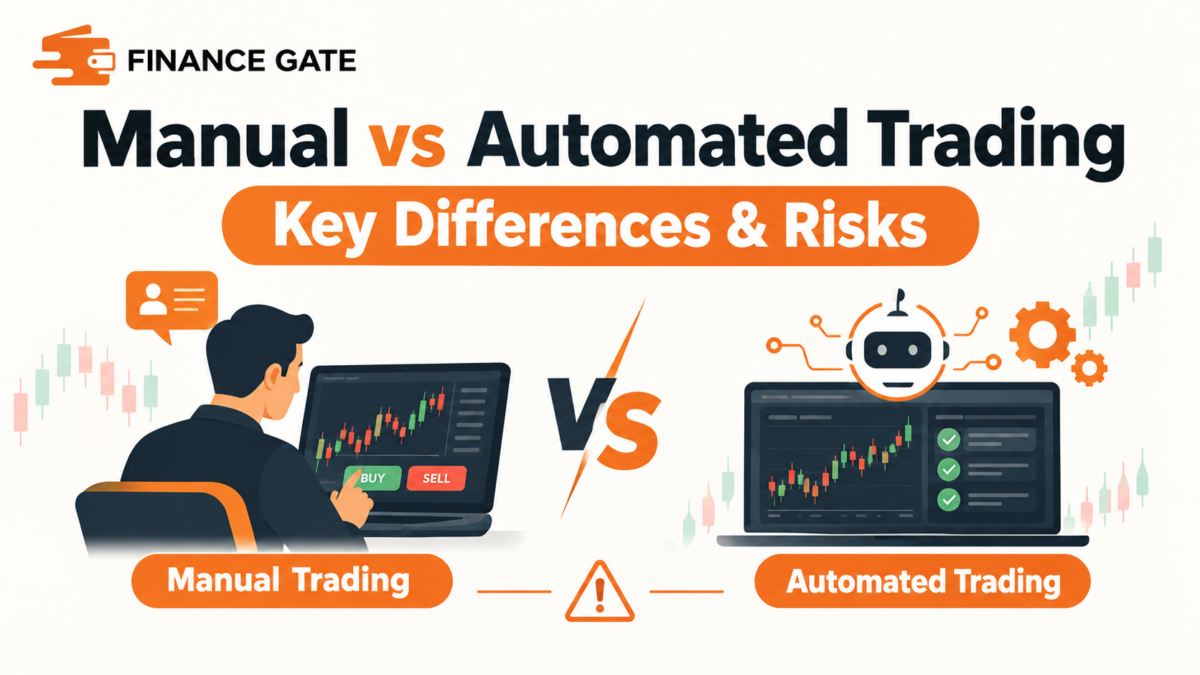
Manual trading and automated trading are two different ways to make and execute trading decisions. Manual trading relies on a person’s judgment to analyze the market and place or manage orders, while automated trading uses predefined rules or computer algorithms to perform some or all of those tasks.
Neither method is automatically more profitable. The better approach depends on the trading strategy, the trader’s experience, available time, execution requirements, costs and ability to manage risk.
For traders who want to understand the technology behind automation, FinanceGate’s guide to
financegate.io provides additional context about trading rules, signals and automated execution.
Manual vs Automated Trading at a Glance
| Factor | Manual trading | Automated trading |
|---|---|---|
| Decision-making | Human judgment | Predefined rules, algorithms or models |
| Order execution | Trader places or manages orders | Software can place or manage orders automatically |
| Speed | Depends on human reaction and order-entry process | Can execute instructions quickly when systems and market conditions permit |
| Flexibility | Human can interpret new information directly | Changes depend on system rules, configuration and oversight |
| Emotional influence | Emotions may affect decisions | Automation can reduce some discretionary interference |
| Monitoring | Requires attention when decisions or orders need action | Requires monitoring for errors, connectivity and unexpected behavior |
| Strategy testing | Can involve manual review and historical analysis | Often supports systematic backtesting |
| Setup | May require little specialized software | May require suitable software, data, configuration and testing |
| Main risks | Emotional decisions, inconsistent execution and missed opportunities | Software errors, flawed rules, bad data and unexpected execution |
| Best suited to | Traders who value discretion and direct control | Traders who need repeatable, rule-based processes and can supervise them |
The table describes common approaches rather than every trading setup. Manual traders can use sophisticated software, and automated systems can still require substantial human supervision.
What Is Manual Trading?
Manual trading is a process in which a person makes trading decisions and directly initiates or manages orders. The trader may examine price charts, technical indicators, company announcements, economic data or other market information before deciding whether to enter, adjust or exit a position.
The process does not have to be entirely technology-free. A manual trader might use charting software, screeners, financial news and price alerts while retaining control over the final decision and order.
How manual trading works
A typical manual trading process follows these steps:
- Analyze the market. Review relevant price movements, news, market conditions and other information.
- Identify a potential setup. Determine whether the available evidence meets the conditions of a trading strategy.
- Evaluate risk. Consider position size, potential loss, liquidity, transaction costs and possible exit conditions.
- Place or manage the order. Enter, modify or cancel an order through the chosen brokerage or trading interface.
- Monitor the position. Reassess the trade as prices and relevant information change.
- Review the outcome. Record the decision, execution and result to identify possible improvements.
A manual trader can follow strict rules. The defining characteristic is that a person performs the relevant decision-making or execution steps rather than delegating them entirely to software.
Benefits of manual trading
- Direct control: The trader decides when to act and can choose whether to follow a particular signal.
- Contextual judgment: A person can consider unexpected news or circumstances that a fixed strategy may not account for.
- Flexible decision-making: The trader can adapt an approach when the original assumptions no longer seem appropriate.
- Clear decision ownership: The trader can review the reasoning behind each decision.
- Accessible starting point: Basic manual trading can be practiced using charts, a trading interface and a written plan without developing a custom algorithm.
Limitations of manual trading
Manual trading requires attention and discipline. Monitoring several markets or reacting to frequent signals can become demanding, particularly when decisions need to be made quickly.
Human judgment also has limitations. Fear, overconfidence, frustration and the desire to recover losses can lead to inconsistent decisions. A trader might abandon a tested strategy after a small losing streak or enter a position without completing the planned risk assessment.
Manual trading is not inherently more accurate simply because a human makes the decision. Its quality still depends on the strategy, the information available and the consistency of execution.
What Is Automated Trading?
Automated trading uses software to carry out trading tasks according to predefined instructions or algorithms. Depending on the system, software may identify trading signals, calculate order sizes, submit orders, manage exits or perform several of these tasks together.
Some systems automate only order execution after a person makes the trading decision. Others generate signals and manage orders with limited intervention.
FinanceGate’s
financegate.io explains the broader relationship between algorithms, trading signals and execution.
How automated trading works
A typical automated workflow includes five stages:
- Define the rules. Specify the conditions that trigger a trading action.
- Supply market data. The system receives the information required to evaluate those rules.
- Evaluate conditions. Software determines whether the predefined criteria have been met.
- Generate or execute orders. Depending on its configuration and permissions, the system can generate an alert, propose an order or submit an order automatically.
- Monitor and review. The trader checks execution, system behavior and risk limits, and investigates unexpected outcomes.
For example, a hypothetical system could be programmed to generate a signal when a short-term moving average crosses above a longer-term moving average. That signal does not guarantee a profitable trade. It simply indicates that the programmed condition has occurred.
Benefits of automated trading
- Consistent rule execution: Software can apply the same programmed conditions repeatedly without discretionary changes to each signal.
- Potentially faster execution: A system can act without waiting for a person to manually enter every instruction, provided the infrastructure and market conditions support it.
- Reduced routine workload: Repetitive monitoring and order-management tasks can be automated.
- Systematic testing: Historical data can be used to evaluate how a strategy would have behaved under specified assumptions.
- Repeatability: Recorded rules and logs can make it easier to examine whether a system followed its intended process.
These benefits relate to process and execution. They do not establish that automated trading will outperform manual trading or generate positive returns.
Limitations of automated trading
Automated trading replaces some manual tasks with technical and operational responsibilities.
A strategy may be based on flawed assumptions, inaccurate data or a pattern that no longer works. Software can also behave unexpectedly because of coding errors, connectivity problems, incorrect settings or an interaction between multiple orders.
Automation can make mistakes happen repeatedly before anyone notices them. A person who trusts a system without checking its behavior may overlook accumulating losses or unintended positions.
Other potential drawbacks include:
- Software development, subscriptions, market-data and infrastructure costs.
- Time spent testing, maintaining and updating the system.
- Dependence on data quality and execution arrangements.
- Overfitting, where a strategy appears successful on historical data but performs poorly on new data.
- The need for clear risk limits, monitoring and procedures for stopping the system.
The
finra.org discusses the importance of risk assessment, testing, system validation and ongoing controls in professional trading environments. Its requirements and recommendations should be interpreted in their relevant regulatory context, rather than assumed to apply identically to every retail trader.
FINRA
The Differences That Matter Most
Understanding the practical differences is more useful than deciding which approach sounds more sophisticated.
1. Human control versus rule-based execution
Manual trading allows the trader to evaluate information and make discretionary decisions at the point of action. Automated trading follows the instructions and permissions built into the system.
This distinction is not absolute. A trader can manually approve every order generated by an algorithm, while a manual trader may follow a strict checklist with little discretion.
The key question is how much decision-making authority remains with the person.
2. Execution speed and consistency
Automation can evaluate conditions and submit orders without the delay involved in manual observation and order entry. However, actual execution depends on software, connectivity, broker infrastructure, liquidity and the type of order used.
Speed also has different levels of importance for different strategies. A strategy that depends on rapid reactions may be sensitive to execution delays. A longer-term strategy may place much greater importance on research, costs and risk management.
Fast execution alone does not create a trading advantage.
3. Emotional decisions and discipline
Manual traders may change plans because of fear, excitement or frustration. Automated systems can help enforce predefined rules by reducing the opportunity for impulsive intervention.
But automated trading does not remove every emotional or behavioral problem. A trader can still change the algorithm after a loss, disable it at an inconvenient moment or increase its risk after a successful period.
The system can also execute a poorly designed rule without hesitation. Discipline is still needed when designing, supervising and reviewing the strategy.
4. Flexibility and changing market conditions
Manual traders can interpret unexpected developments and make discretionary adjustments. This can be useful when information is ambiguous or circumstances differ from the original plan.
An automated system can respond to changing conditions only to the extent that its rules, inputs and design allow. Some systems include predefined responses to volatility, liquidity changes or risk limits. Others may continue operating even when the assumptions behind their strategy have weakened.
Neither approach guarantees a correct response to unexpected events.
5. Time and monitoring
Manual trading often requires a person to review signals, make decisions and manage orders during relevant market periods.
Automated trading can reduce repetitive work, but it does not eliminate supervision. Traders still need to monitor system health, check orders, review risk exposure and investigate unexpected activity.
A system that runs without constant manual input is not necessarily a system that can safely be left unattended.
6. Costs and trading friction
The total cost of a trading method includes more than a visible commission.
Relevant costs may include:
- Bid-ask spreads.
- Slippage between the expected and actual execution price.
- Brokerage and exchange fees, where applicable.
- Market-data subscriptions.
- Software, computing and infrastructure expenses.
- Time spent researching, testing and maintaining the process.
Manual trading can have higher time demands. Automated trading can introduce additional technical expenses, depending on the setup.
The right comparison considers total costs relative to the strategy’s actual requirements. Neither method is automatically cheaper in every situation.
For readers studying risk and execution, FinanceGate’s guide to
financegate.io explains why spreads, volatility and other market information need context rather than being interpreted as standalone signals.
Manual Trading vs Automated Trading: Advantages and Disadvantages
The following summary brings the main trade-offs together.
| Consideration | Manual trading | Automated trading |
|---|---|---|
| Initial learning | Learn market analysis, order types and risk management | Learn those concepts plus system rules and relevant technology |
| Adaptability | Can interpret unfamiliar circumstances directly | Depends on programmed responses and human intervention |
| Repeatability | Depends on the trader’s consistency | Can apply rules consistently when correctly configured |
| Historical testing | Possible, but may involve manual analysis | Often supports systematic backtesting |
| Operational complexity | Primarily human and execution-related | Includes software, data, connectivity and execution dependencies |
| Emotional control | Requires deliberate behavioral discipline | Can reduce some impulsive actions but still needs human discipline |
| Scalability | Attention can become a constraint | Software may process multiple signals, subject to system capacity |
| Risk of repeated errors | Human mistakes can recur | A coding or configuration error can affect many orders |
| Oversight | Human decisions and positions need review | Both the strategy and system behavior need review |
A useful distinction is that consistency is not the same as correctness. An automated system can apply a bad rule consistently. A manual trader can follow a sound strategy inconsistently. Both problems can undermine the intended approach.
A Practical Example: The Same Trading Rule, Two Methods
Consider a hypothetical trader who wants to evaluate a moving-average crossover strategy. The purpose of this example is to illustrate process differences, not to recommend the strategy or predict its performance.
Manual workflow
- The trader reviews the chart and identifies a crossover.
- The trader checks the planned entry conditions and risk limits.
- The trader decides whether to place an order.
- The trader monitors the position and manages the exit.
Automated workflow
- The software checks incoming data for the defined crossover condition.
- The system checks its programmed eligibility and risk rules.
- It generates an alert or submits an order, depending on its configuration.
- It follows its exit rules while the trader monitors system health and execution.
The automated workflow may reduce manual steps, but it introduces dependencies on data, code and system configuration. The manual workflow offers direct judgment but depends on the trader’s attention and consistency.
To compare the approaches fairly, both should be evaluated using the same underlying strategy rules and realistic assumptions about execution costs.
A backtest should account for factors such as transaction costs, slippage, data quality and the risk of overfitting. Historical results alone do not establish how a strategy will perform in live markets.
Which Trading Approach Is More Suitable for Beginners?
Neither manual nor automated trading is automatically appropriate for every beginner. A useful starting point is to consider the skills and responsibilities involved before choosing a method.
| If your priority is… | What to consider |
|---|---|
| Learning how markets and orders work | Manual analysis and simulated trading can help make the decision process visible. |
| Reducing repetitive tasks | Automation may help once the rules and limitations are understood. |
| Avoiding impulsive order entry | A written plan and predefined risk controls can help; software may enforce some rules. |
| Using a strategy with clear, testable conditions | Automation may be worth evaluating after appropriate testing. |
| Responding to unusual news or circumstances | Consider how the method handles events outside its normal assumptions. |
| Keeping technical complexity low | Manual execution may involve fewer software-development responsibilities. |
Can beginners use automated trading?
Yes, beginners can learn about and experiment with automated trading, but they should understand how a system works before allowing it to place live orders.
A sensible learning process is to:
- Understand the underlying trading rules.
- Learn the order types and risk limits involved.
- Test the strategy using historical data with realistic assumptions.
- Use a simulator or paper-trading environment where available.
- Check how the system handles errors, rejected orders and unexpected market conditions.
- Understand all software, data and trading costs.
- Avoid risking money they cannot afford to lose.
Paper trading can help evaluate the workflow, but simulated fills and market conditions may differ from live execution.
The U.S. SEC and FINRA have also warned investors to understand the assumptions, limitations, costs and risks of automated investment tools rather than relying on claims of superior performance. These tools include several categories, so portfolio-management services should not be confused with trading bots.
Investor
+1
Common Mistakes to Avoid
Regardless of the chosen method, several mistakes can undermine the process.
Assuming automation guarantees profit. Software executes instructions; it does not make an ineffective strategy profitable.
Ignoring transaction costs. A strategy can look attractive before spreads, slippage and other expenses are considered.
Overfitting historical data. A strategy designed too closely around past observations may fail on new data.
Using unreliable data. Missing, delayed or incorrect inputs can cause decisions that do not reflect actual market conditions.
Ignoring system failures. Connectivity problems, duplicate orders, unexpected positions and rejected orders need defined handling procedures.
Changing rules without testing. Frequent adjustments based on a small number of outcomes can make a strategy harder to evaluate.
Removing human oversight. Automated processes still need monitoring, risk limits and a clear method for pausing or stopping activity.
Confusing execution with analysis. A system that automatically places orders is not necessarily a system that independently analyzes the market or generates its own signals.
For a related perspective on market information, FinanceGate’s guide to
financegate.io explores the market-analysis side of trading research. Identifying an unusual price move, however, is not the same as establishing a reliable trading signal.
Can Manual and Automated Trading Be Combined?
Yes. A hybrid approach uses human judgment for selected decisions and software for specific repeatable tasks.
For example, a trader might manually review market conditions and decide which setups are eligible, then use software to calculate position sizes or manage predefined exit rules. Another trader might use automated alerts but manually approve each order.
A hybrid workflow can preserve discretionary oversight while reducing repetitive work. It also creates its own responsibilities: the trader must understand which actions are automated, when human approval is required and what happens if the two processes conflict.
A useful hybrid setup should define:
- Which decisions remain manual.
- Which tasks software can perform.
- What limits apply to orders and positions.
- How errors and unexpected conditions are handled.
- When the system should be paused.
- How performance and execution quality will be reviewed.
The aim is not to combine both approaches merely for the sake of using more technology. It is to assign each task to a process that can handle it appropriately.
Frequently Asked Questions
What is the difference between manual and automated trading?
Manual trading relies on a person to make or execute trading decisions. Automated trading uses software to apply predefined rules to signals, order management or execution. Some systems automate only one stage of the process, while others handle several stages with limited human intervention.
Is manual trading better than automated trading?
Neither approach is universally better. Manual trading offers direct human judgment, while automation can improve the consistency of repetitive rule-based tasks. The more appropriate method depends on the strategy, available time, costs, technical requirements and ability to manage risk.
Is automated trading the same as algorithmic trading?
The terms overlap but are not always identical. Algorithmic trading uses computer-based rules or models to support trading decisions or execution. Automated trading describes the automation of trading tasks more broadly, including systems that automate order execution after a human makes the decision.
Does automated trading eliminate emotional decisions?
No. Automation can reduce some impulsive decisions by following predefined rules, but it cannot eliminate every behavioral problem. A trader may change the rules after losses, intervene at the wrong time or configure an excessively risky strategy. Human oversight remains important.
What are the main risks of trading bots?
Trading bots can suffer from flawed strategy rules, coding mistakes, poor-quality data, connectivity failures, unexpected orders, slippage and overfitting. Their actual risks depend on how they are designed, configured, connected to trading infrastructure and monitored.
Is automated trading suitable for beginners?
It can be studied by beginners, but live automation requires an understanding of trading rules, order execution, costs and operational risks. Simulations and paper trading can help with learning, although their results may not reflect live execution accurately.
Is manual trading more flexible than automated trading?
Manual trading can adapt directly to circumstances that require human interpretation. Automated trading is limited by its programmed logic and available inputs, although well-designed systems can include responses to different market conditions. Neither method guarantees better judgment.
Can traders combine manual and automated strategies?
Yes. A trader can use human analysis to identify opportunities and software to generate alerts, calculate position sizes or manage predefined orders. The process should clearly specify which decisions are manual, which are automated and how risk controls operate.
Does automated trading always execute orders faster?
No. Software can process instructions without manual order entry, but actual execution speed depends on the system, network, broker infrastructure, order handling and market conditions. Faster execution does not necessarily improve the overall outcome.
Does backtesting prove that a trading strategy will work?
No. Backtesting evaluates how rules would have behaved on historical data under specified assumptions. Results can be distorted by overfitting, poor data, unrealistic execution assumptions and changing market conditions. Live performance can differ substantially from historical results.
Conclusion: Manual Trading vs Automated Trading
Manual trading gives traders direct involvement in analysis and execution. Automated trading can make repetitive, rule-based tasks more consistent, but it also introduces software, data and operational risks. Neither method guarantees better results, and neither removes the need for a well-defined strategy and risk controls.
The most useful comparison is not simply which method is faster or easier. It is which process fits the strategy’s requirements, can be tested realistically and can be monitored responsibly. For some traders, manual decision-making will remain central. Others may benefit from automation or a carefully defined combination of both.


 Muhammad Bilal